
Laden Roller Brake Testing Requirements (in force since April 2025)
Since April 2025, the DVSA requires that roller brake tests (RBTs) carried out as part of safety inspections should be performed with the vehicle laden wherever practicable. This update is included in the Guide to Maintaining Roadworthiness and applies to all operators maintaining vehicles under an inspection programme.
Brake Testing Requirements for Operators
The DVSA expects that:
- Every safety inspection includes a brake performance assessment.
- The assessment must be evidenced and retained with maintenance records.
- Where possible every attempt must be made to conduct a laden roller brake test
- If a laden test is not possible, a written risk assessment must explain why and be reviewed by a competent person.
- A laden roller brake test carried out up to 14 days before the inspection can be used as evidence for that inspection.
- Electronic Brake Performance Management System (EBPMS) can also be used to assess braking performance.
- As minimum, operators must complete at least four laden RBTs per year, spaced evenly across the maintenance schedule.
If you need help deciding how to best test your vehicles or want guidance in writing a risk assessment, reach out.
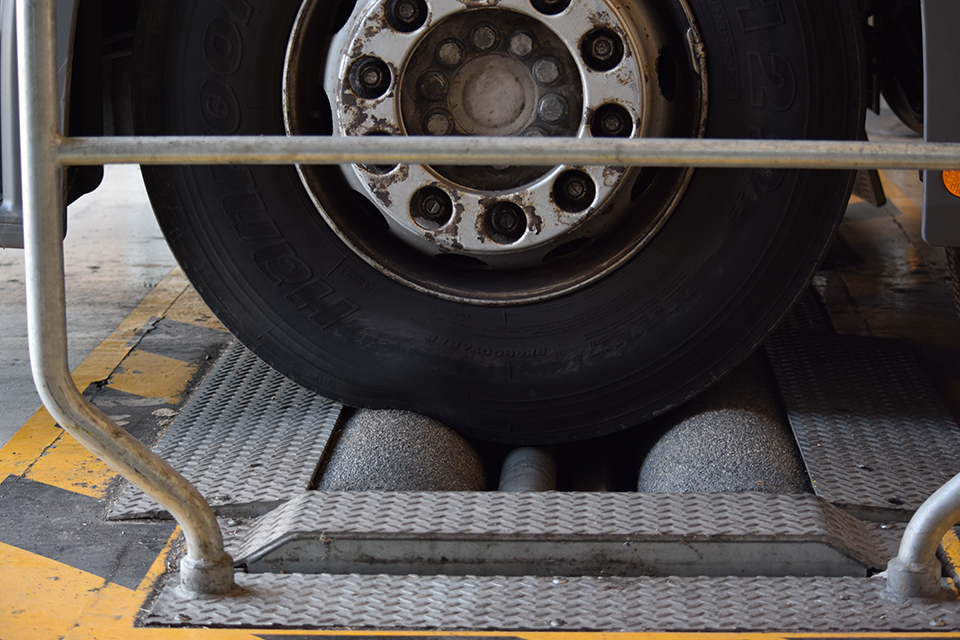
Unladen Brake Tests
Unladen brake tests may not fully reflect how brakes perform when the vehicle is carrying a load. Laden tests provide a more accurate measure of braking efficiency, helping to identify defects that could affect road safety. Unladen brake tests cannot be relied upon.
When a Brake Test Will Fail
During a roller brake test, a vehicle will fail if any of the following occur:
- Bind (service brake only): more than 4% of the measured axle weight
- Time lag: significant delay between brake application and response (manually assessed)
- Ovality: difference of 70% or more between the highest and lowest brake reading
- Imbalance (service and designated secondary brake only): more than 30% difference between wheels on the same axle (if imbalance is over 25%, the operator is required to investigate)
- Max force: less than 5% of required braking force
If a vehicle fails any of these checks, the result will appear under the ‘Unsatisfactory wheel performance’ section of the report.
Electronic Brake Performance Monitoring Systems (EBPMS)
An EBPMS is an approved system fitted to a vehicle or trailer that continuously monitors brake performance. It collects data from electronic braking components and automatically generates reports showing the effectiveness of braking over time.
How EBPMS Works in Practice
- The system records live braking performance information during normal operation.
- This data is transmitted to an analysis platform that produces regular brake performance reports, which are available to the operator through an online platform.
- These reports can be used as evidence of brake testing when reviewed and interpreted by a competent person.
Exemptions
The DVSA recognises that in some cases a laden test may not be practicable. Where this occurs, a documented risk assessment is required. The risk assessment must be completed by a competent person and retained with maintenance records.
Record keeping
Brake test results, risk assessments, and any EBPMS data used as evidence must be retained for at least 15 months.
Fleet Planner offers an effective, paperless solution for storing records, along with reminders and professional review.
Read more about our software.
Summary
The DVSA changes that came into effect in April 2025 make laden roller brake testing the standard for most vehicles. Unladen tests should only be carried out when a documented risk assessment justifies it. Operators using EBPMS may reduce manual testing if their systems provide valid data and are reviewed by a competent person.
Source
- DVSA – Guide to Maintaining Roadworthiness (2025 update)
- DVSA – The heavy vehicle brake test best practice guide
It is a requirement of the vehicle operator to be able to properly assess brake testing results.
To our best knowledge this information is correct as of 14 October 2025. Always refer to the latest DVSA guidance before making operational or compliance decisions.