
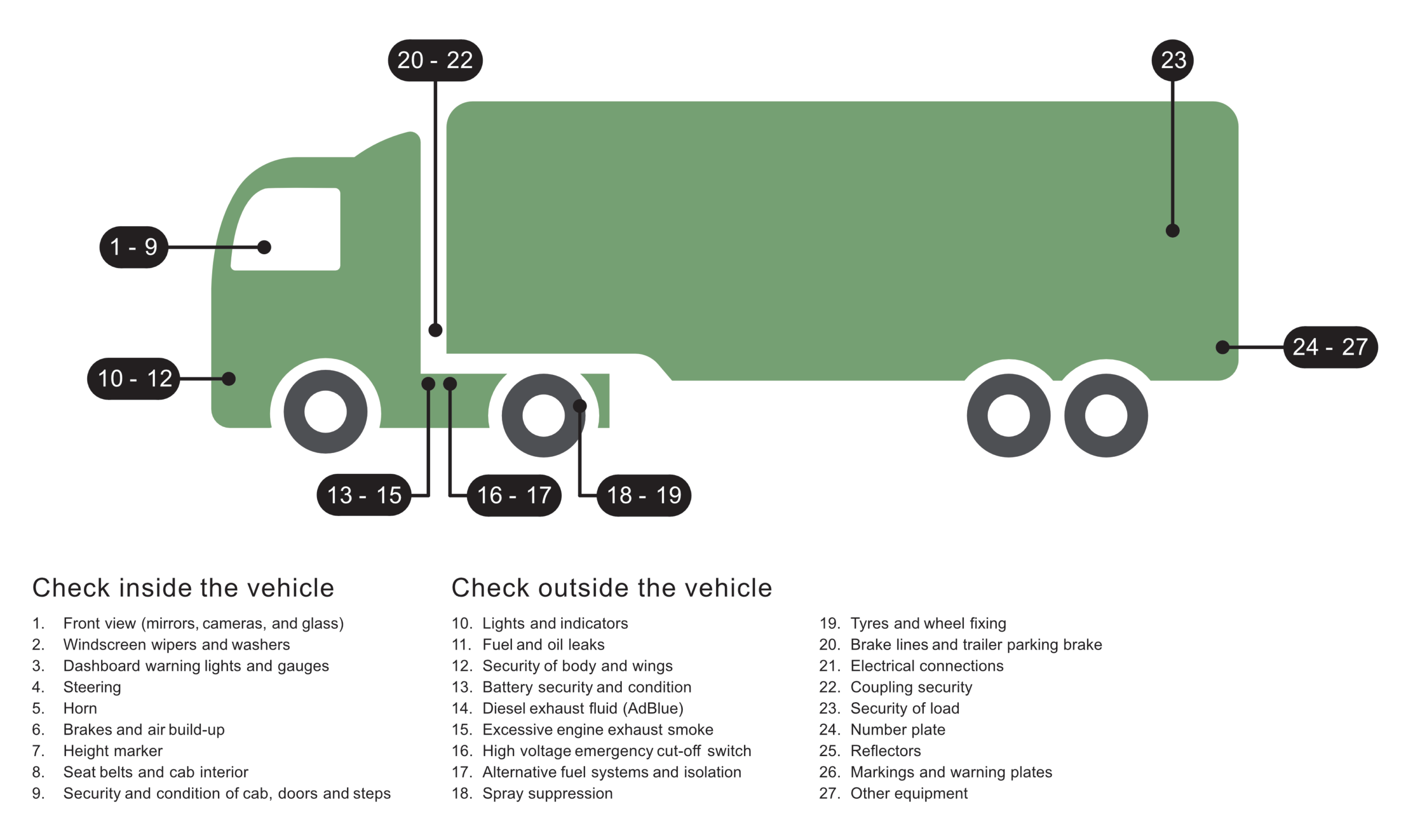
Full guide along with the above diagram available here.
What Is a Daily Walkaround Check?
A daily walkaround check is a legally required inspection carried out by a driver or responsible person before a commercial vehicle is used on the public highway.
It is designed to identify visible defects that could affect vehicle roadworthiness, safety, or legal compliance.
Daily walkaround checks apply to:
- Heavy Goods Vehicles (HGVs)
- Public Service Vehicles (PSVs – buses and coaches)
- Light Goods Vehicles (LGVs) operating under an operator licence
- Trailers used in commercial operations
The requirement is set out in DVSA guidance and forms a core part of an operator’s roadworthiness maintenance system.
Are Daily Walkaround Checks a Legal Requirement?
Yes.
Drivers and operators have a legal duty to ensure that vehicles are roadworthy before they are used on the road.
Using an unroadworthy vehicle is a criminal offence. Both the driver and the operator can be held responsible.
Traffic Commissioners assess maintenance systems against DVSA’s Guide to Maintaining Roadworthiness (Updated April 2025). Daily walkaround checks are a mandatory component of that system.
How Often Must a Daily Walkaround Check Be Completed?
A walkaround check must:
- Be completed before the vehicle is used on the public highway
- Be carried out at least once in every 24-hour period that the vehicle is in service
In higher-risk operations (off-road work, construction, trailer swaps, urban multi-drop), additional checks may be required.
Operational convenience does not override safety requirements.
Who Is Responsible for Completing a Walkaround Check?
The driver is legally responsible for the condition of the vehicle while it is in use.
However:
- The operator remains legally responsible for ensuring vehicles are maintained in a fit and serviceable condition.
- The check can be delegated to a responsible person — but the driver must be satisfied the vehicle is roadworthy before driving.
Responsibility is shared. Liability can fall on both parties.
What Must Be Checked During a Daily Walkaround Check?
A daily walkaround check must cover all items that can be safely assessed without dismantling the vehicle.
Typical items include:
- Tyres (condition, tread depth, inflation, damage)
- Wheels and wheel fixings
- Lights and indicators
- Reflectors and registration plates
- Mirrors and glass
- Bodywork and load security
- Trailer coupling and connections
- Brake system warning lights
- Fluid leaks
- ISO/EBS lead connections (for trailers)
- In-cab warning lamps
If a safety-related defect is identified, the vehicle must not be used until it is rectified.
Daily Walkaround Checks: Minimum Legal Requirements
To remain compliant, operators must ensure:
- A meaningful walkaround check is completed before use.
- At least one check is completed every 24 hours in service when vehicle is used
- Defects are recorded in writing or electronically.
- “Nil defect” reporting is captured where no faults are found.
- Defects affecting roadworthiness are rectified before the vehicle returns to service.
- Records are retained for a minimum of 15 months.
Failure in any of these areas may indicate a significant failure of roadworthiness compliance.
What Is a Driver Defect Report?
A driver defect report is the formal record of any fault identified:
- During the daily walkaround check
- While the vehicle is in use
- On return to base
The report must include:
- Vehicle identification
- Date
- Details of the defect
- Who reported it
- Who it was reported to
- Rectification details
- Confirmation of repair
Electronic driver defect reporting systems are acceptable provided they are secure, date/time stamped, and auditable.
What Happens If Daily Walkaround Checks Are Not Completed?
Failure to conduct meaningful daily walkaround checks can lead to:
1. Roadside Prohibitions
If defects are identified during a DVSA inspection that should have been detected during a daily check, a prohibition may be issued.
Serious cases may be marked as a significant failure of roadworthiness compliance (“S-marked”).
2. Fixed Penalty Notices
Certain roadworthiness defects (brakes, tyres, steering) may result in penalties and licence endorsement.
3. Increased OCRS Score
The Operator Compliance Risk Score (OCRS) may increase, leading to:
- More roadside stops
- Greater enforcement scrutiny
4. Maintenance Investigation Visit (MIVR)
Repeated failures may trigger a DVSA maintenance investigation.
How Do Daily Walkaround Checks Protect Your Operator Licence?
Daily walkaround checks demonstrate:
- Active management control
- Effective defect reporting systems
- A functioning maintenance culture
- Compliance with operator licence undertakings
They are the frontline control mechanism of a compliant roadworthiness system.
A safety inspection every 6 weeks cannot compensate for 6 weeks of poor daily checks.
Monitoring the Quality of Daily Walkaround Checks
Operators should not simply rely on form completion.
Effective monitoring includes:
- Comparing safety inspection defects against daily defect reports
- Reviewing tachograph data to confirm time allocated to checks
- Conducting spot re-inspections
- Analysing patterns of repeated faults
- Monitoring nil defect reporting trends
A high volume of roadside defects combined with consistent nil reports is a regulatory red flag.
DVSA Guidance Reference
The requirements outlined above align with the DVSA Guide to Maintaining Roadworthiness: Commercial Goods and Passenger Carrying Vehicles (Updated 28 April 2025).
Traffic Commissioners use this guidance as the benchmark for assessing whether maintenance arrangements are satisfactory.
Operators are expected to demonstrate systems that meet — or exceed — this standard.